Until the second century BC, the Maghreb was dominated by Punic power. Carthage first faced the Greeks and then, more fiercely, Rome, the rising power in the Mediterranean. After years of conflict, the Roman legions defeated Carthage in 146 BC. The city was razed, and its site was “cursed” and “dedicated to the gods”.
Tangier then fell under the sway of the Roman world. Around 80 BC, a democratic general, Sertorius, former governor of Lower Spain, revolted against Sulla’s supporters. He abandoned a planned landing at the Fortunate Isles (Madeira) and went to Mauretania, where he intervened in conflicts between local princes and seized Tingis. The Tingitans apparently appreciated Sertorius’s rule, and hundreds of them followed him to Spain when he was recalled there by the Lusitanians some time later.
Until 38 BC, the city retained a unique status—already!—that distinguished it from the rest of Mauretania. This status was due to kings like Bocchus I (died 80 BC), a close friend of Sulla, and his sons Bogud and Bocchus II. After the partition of Mauretania into western and eastern kingdoms in 70 BC, Bogud became king of the western part. The city was the center of a small principality whose most famous princes were Iphtas and Ascalis. In 38 BC, Octavian, the future Emperor Augustus, elevated Tingis to the status of a colony. The city’s inhabitants thus became full Roman citizens.
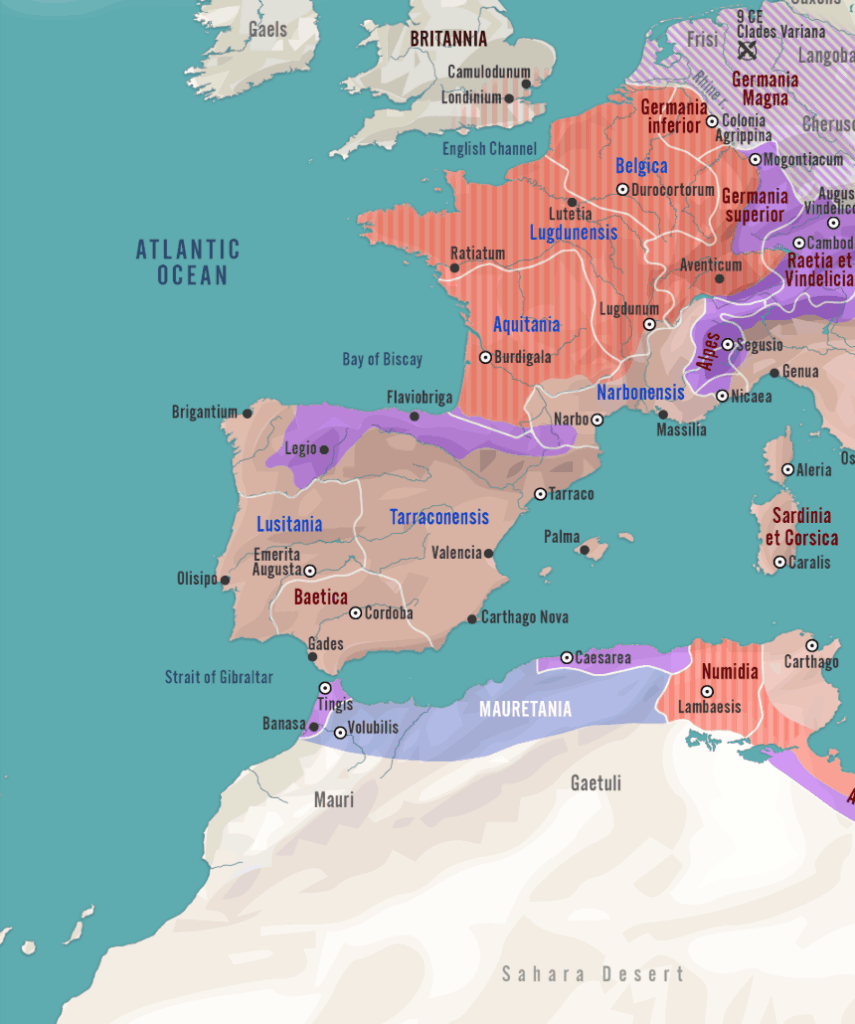
In 25 BC, Augustus installed Juba II, son of Juba I, as king of an enlarged Mauretania incorporating the former possessions of Bogud. Juba II became one of the most celebrated kings of North African antiquity.
He was a king allied with Rome. He was raised in Rome and married by his patrons to Cleopatra Selene, daughter of Cleopatra and Mark Antony. From this union was born Ptolemy. Upon Juba II’s death (in 23 or 24 BC), his son succeeded him and reigned for seventeen years over Mauretania, leaving the government in the hands of his freedmen. He fought alongside the Romans against the Berber rebels led by Tacfarinas, but, as the only reward for his loyalty, he was assassinated in Lyon on the orders of Caligula in 40 AD. Ptolemy’s death provoked a bloody revolt in Tangier. The rebels were led by Aedemon, a freed slave of Ptolemy. In the confrontation with the Roman legions, the city was destroyed. Emperor Claudius annexed Mauretania (in 42 AD) and divided it into two provinces: Mauretania Tingitana and Mauretania Caesariensis. He elevated Tingis to the status of Metropolis of Mauretania Tingitana, that is, capital of the western province.
Roman cities generally had two more or less perpendicular streets. One of these streets ran north-south and was called the cardo maximus, and the other ran east-west and was called the decumanus maximus. These two main streets intersected at the forum. Tingis was no exception. Two main gates date from this period: the entrance to Syaghine Street and Bab El Marsa. A direct axis connected these two gates. As for the forum, it was located on the site of the present-day Petit Socco. It was the symbol and center of public life. Magistrates read the announcements, celebrated sacrifices, and administered justice. Citizens came to vote, pay their taxes, trade, or gamble on the stock exchange. There must certainly have been a temple, a theater, baths, and a triumphal arch in Tingis. During the construction of a house in the present-day medina, a white marble statue, over 2 meters tall and weighing over 500 kg, known as the Vesta Goddess, was discovered. Two roads were built from the city under Septimius Severus: Tingis-Sala (Chella) and Tingis-Volubilis. The emperor’s African origins (Tripoli) were undoubtedly a factor in his urban development efforts in Mauretania.
The traces of industrial activity that have survived from this period date back to the first century BC. Most are linked to the sea. In the Cotta factory, which was active from the 3rd century BC to the 3rd century AD, workers prepared salted fish and garum, a condiment the Romans were fond of. Whales were exploited there, and purple dye was extracted to color the togas of Roman senators. At the end of the 2nd century, an economic crisis took hold, with a scarcity of gold and soaring inflation. The monetary economy was gradually replaced by barter. The Roman Empire was economically disorganized. This led to political unrest and uprisings, including those of the Berbers. During the reign of Gallienus, Franks had invaded Spain and attacked the coast of Mauretania.
At the end of the 2nd century, an economic crisis took hold, marked by a scarcity of gold and soaring inflation. The monetary economy was gradually replaced by barter. The Roman Empire was economically disorganized. This led to political unrest and uprisings, including those of the Berbers. During the reign of Gallienus, Franks invaded Spain and attacked the coast of Mauretania.
Christianization began around 180 AD. The period from the 2nd to the 4th centuries was punctuated by economic crises. At the beginning of the 5th century, a small Christian community gathered around a bishop. In 313, Diocletian separated Mauretania Tingitana from the rest of Africa (roughly, the modern-day Maghreb for the Romans) and administratively attached it to the Diocese of Spain. The military commander of Mauretania Tingitana and Spain resided in Tangier.
At the beginning of the 5th century, Rome was overwhelmed by hordes of barbarians. In 429, the Vandals, led by Gaiseric, landed in the region of Tangier (or Ceuta) from Tarifa. Alongside the Vandals were Alans and Suebi: 80,000 people in total, including 15,000 warriors. The Vandals originated in the Baltic region. After several centuries of migration, they pillaged Gaul and then Spain in 409. The Visigoths pushed them back south along the Iberian Peninsula in 416. The Vandals began raiding the coasts of Mauretania Tingitana as early as 425. After years of conflict between the Byzantines and Vandals, the Treaty of Hippo granted the latter the status of federates of the empire and the occupation of all of Mauretania except for the Tingitana region, which remained under Spanish rule.
With Constantinople having taken over from Rome, the Byzantines occupied Ceuta in the 6th century and dominated the city of Tangier, probably more formally than effectively. The city was integrated into the Christian world, like much of the Mediterranean. The Visigoths then seized power in Spain and extended their dominion to Tangier at the beginning of the 7th century.
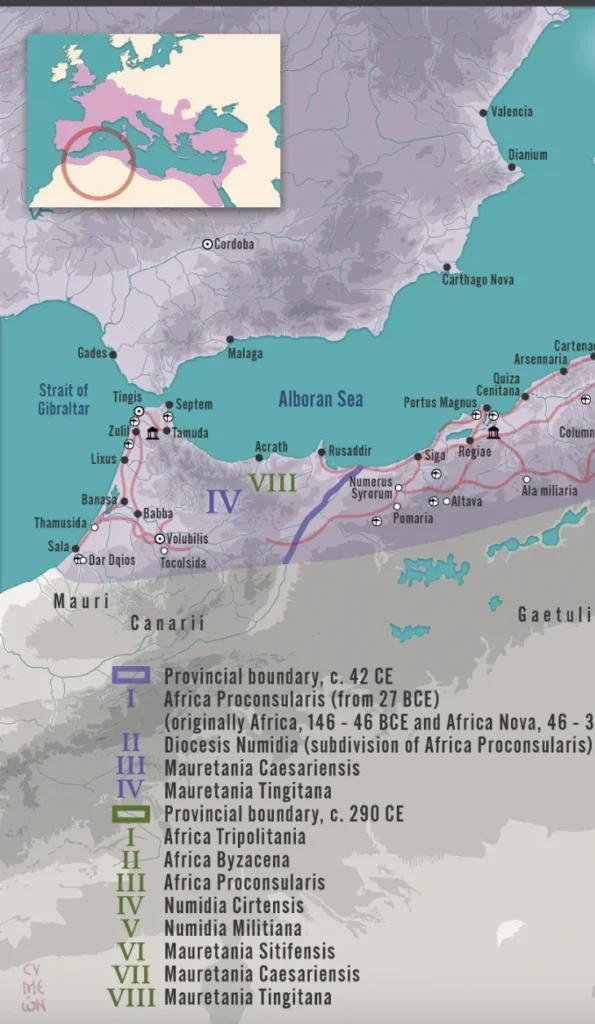
Around 530, Mauretania Tingitana came under the control of an independent Berber principality.
In 533, the Byzantine armies led by Belisarius crushed the Vandals in Numidia, and North Africa returned to Byzantine rule. Tangier and its surrounding region were temporarily annexed to Mauretania Caesariensis because Spain was under Visigothic rule. Fortifications were erected throughout North Africa. No sooner were they completed than the Berbers revolted. Around 600, it seems that Tangier was no longer part of Mauretania Secunda, which at that time included Ceuta (Septem), some cities in Spain, and the Balearic Islands. It had likely fallen under Berber control. North Africa was then the scene of religious conflicts between Catholics and Monophysites, who adhered to a strict monotheism and denied the Trinity. Meanwhile, Islam was rising in the Middle East.